Dulux Avista
Patch Repair Compound 0-10mm
Dulux Avista
Patch Repair Compound 0-10mm

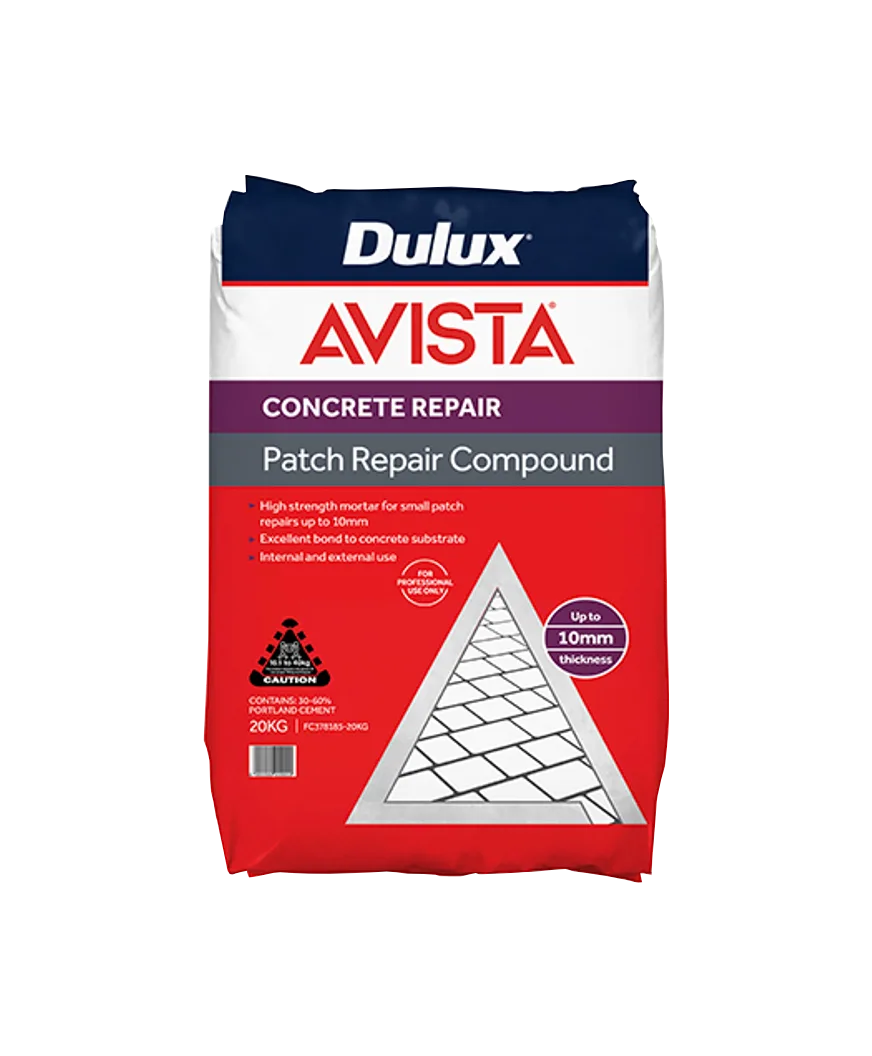
Dulux® Avista® Patch Repair Compound 0-10mm is a high strength mortar for repairing concrete surfaces. It is designed for small concrete repairs and can be applied from feather edge up to 10mm.

Cleaning materials
Water
Application Tools
Trowel
Not to be used when temperature is below 10°C and falling.
Do not mix part bags.
Should not be exposed to moving water during application. Exposure to heavy rainfall prior to the final set may result in surface scour and delamination. If any doubts arise concerning temperature or substrate conditions, consult Dulux Avista Customer Service.
Design criteria
Dulux Avista Concrete Repair Compound is designed for horizontal use. It may be used for small patch repairs from feather edge up to 10 mm. Thicker sections can be reinstalled using Dulux Avista Concrete Repair Compound 3 to 40 mm. Consult Dulux Avista for further information.
Note
To avoid possible reflective cracking in the Dulux Avista Concrete Repair Compound repair, it is essential that live cracks and joints in the substrate be given proper attention. Dulux Avista Patch Repair is not to be used to fill cracks or joints in concrete. Due consideration must always be given to existing joint details and these must be followed through the Dulux Avista Concrete Repair Compound repair; live cracks should be treated by an approved method. Refer to Dulux Avista Crack Repair Kit TDS. For further information, contact your local Dulux Avista Sales Office.
Preparation
Clean the surface and remove any dust, unsound or contaminated material, plaster, oil, paint, grease, corrosion deposits or algae. Where breaking out is not required, roughen the surface and remove any laitance by light scabbling, grit blasting, scabbling or by needle-gun to form a good key.
Oil and grease deposits should be removed by steam cleaning, detergent scrubbing or the use of a proprietary degreaser. The effectiveness of decontamination should then be assessed by pull-off test. Expose fully any corroded steel in the repair area and remove all loose scale and corrosion deposits. Steel should be cleaned back to a bright condition paying particular attention to the back of exposed steel bars. Grit-blasting is recommended for this process. Where corrosion has occurred due to the presence of chlorides, the steel should be high pressure washed with clean water immediately after grit blasting to remove corrosion products from pits and imperfections within the surface.
The prepared area should be blown clean with oil-free compressed air.
Acid wash can also be used to aid adhesion.
Reinforcing steel priming
Apply one full coat of Dulux Metalshield Cold Galv Primer to all exposed reinforcing steel and allow to dry before continuing. If any doubt exists about having achieved an unbroken coating, a second application should be made and, again, allowed to dry before continuing.
Substrate priming
The substrate should be thoroughly soaked with clean water and any excess removed immediately prior to priming. Any areas of the substrate which dry out before application of the primer must be re-dampened before continuing. Thoroughly scrub Dulux Avista Resurfacing Primer diluted (1 part modifier and 3 parts water) into dampened surface taking care to ensure complete coverage particularly around the edges.
Apply the topping whilst the Dulux Avista Resurfacing Primer is still tacky. The priming operation must be repeated if the initial coat has dried out.
Mixing
Care should be taken to ensure that Dulux Avista Concrete Patch Repair Compound is thoroughly mixed. A forced action mixer is essential. Mixing in a suitably sized drum using an approved spiral paddle in a slow speed (400/500 rpm) heavy duty drill is acceptable for the occasional one bag mix. Free-fall mixers must not be used. Mixing of part bags should be attempted.
Place 2.5-3.3L of drinking quality water into the mixer and with the machine in operation, add one full 20 kg bag of Dulux Avista Concrete Repair Compound and mix for 3 minutes until fully homogeneous. Note that powder must always be added to water.
For larger areas, water should be mixed 50:50 with Dulux Avista Resurfacing Primer, for example 1.6L of water and 1.6L of Dulux Avista Resurfacing Primer to yield a 3.2L mix per 20kg per bag.
Application
The mixed Dulux Avista Concrete Patch Repair Compound must be applied onto the primed surface before it dries. Areas which dry too soon must be scrubbed clean and reprimed exactly as described above before continuing. Apply the mixed Dulux Avista Concrete Patch Repair Compound onto the primed substrate as soon as possible after mixing. The mortar should be applied evenly by trowel and tamped in place with wood float to ensure full compaction. Thoroughly compact the mortar around any exposed steel reinforcement. Dulux Avista Concrete Patch Repair Compound can be applied up to 10 mm thickness in single applications.
Build up
Sections greater than 10mm thickness can be achieved by application of multiple layers should be scratch-keyed, covered with polythene sheeting secured at the edges, and allowed to set for a minimum of 7 hours (at 23°C) before continuing. Dampening down as described above, and a further application of Dulux Avista Concrete Patch Repair Compound may proceed at this time.
Finishing
Dulux Avista Concrete Patch Repair Compound should be struck off to the correct level and finished with a steel trowel to fully close the surface. The completed surface should not be overworked. If overcoating with resurfacing product, strike off with a straight edge and then finish with a wooden float to provide a good key
Low temperature working
In cold conditions down to 10°C, the use of warm water (up to 30°C) is advisable to accelerate strength development. Normal precautions for winter working with cementitious materials should then be adopted. The material should not be applied when the substrate and/or air temperature is 10°C and falling. At 10°C static temperature or at 10°C and rising, the application may proceed.
High temperature working
At ambient temperatures above 30°C, the material should be stored in the shade and cool water used for mixing.
Curing
Dulux Avista Concrete Patch Repair Compound is a cement-based repair mortar. In common with all cementitious materials, Avista Concrete Patch Repair Compound must be cured immediately after finishing in accordance with good concrete practice. Plastic or wet hessian is recommended to help slow the curing process.
Overcoating with protective finishes
Dulux Avista Concrete Patch Repair Compound is extremely durable and will provide an excellent hard wearing surface to the repaired locations. A decorative resurfacing finish may be applied over the repair area after approximately 4 - 6 hours. Priming is not required before applying Dulux Avista Resurfacing system (dampening the surface is sufficient).
Cleaning
Dulux Avista Concrete Patch Repair Compound and Dulux Avista Resurfacing Primer should be removed from tools, equipment and mixers with clean water immediately after use. Cured material can only be removed mechanically.