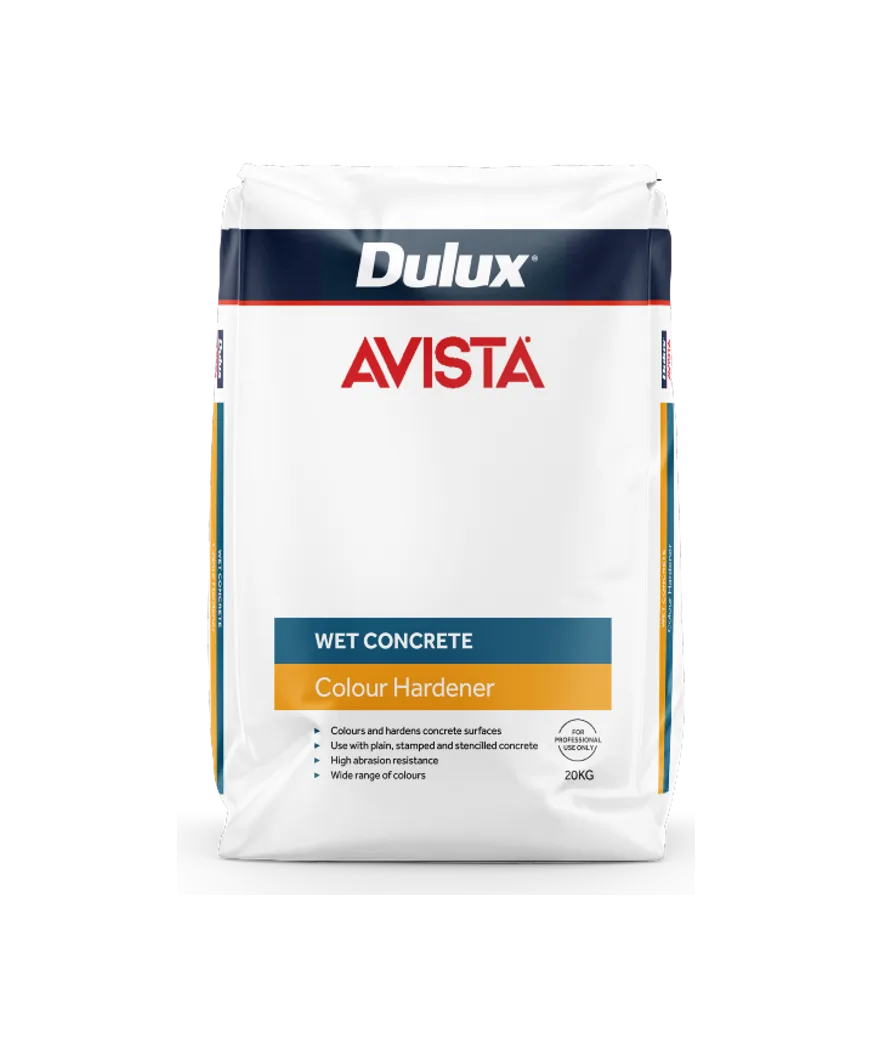

Dulux® Avista® Colour Hardener is a coloured cement based powder designed to colour and harden concrete surfaces. It is applied by hand casting over freshly poured concrete and is ready to use in premixed colours.
Control of application time to concrete set is most important.
Application rate controls even colouration and strength.
Applied over too much surface water leads to an uneven patchy appearance with low strength.
One heavy application tends to be uneven, crusty and can fracture in a honeycomb unacceptable appearance. Adhesion can be affected.
Steel trowelling can result in a smooth finish texture, which may cause a hazardous slip factor. The use of a wood or magnesium float will produce a more textured, less slippery finish.
Freshly poured concrete
Avista Colour Hardener is broadcast in a minimum two separate, even coats after concrete has been screeded and bull floated. Avista Colour Hardener is applied by hand casting to freshly poured concrete. Ensure gloves and protective mask is worn. Dusting and/or colour staining may occur on surrounding exposed surfaces or structures. Masking with plastic sheeting is recommended where appropriate.
Apply first coat after bleed water has disappeared, as hydrating bleed water may cause delamination.
Apply at the rate of approximately 8-15 square metres per 20 kg bag (recommended 8m2 per bag for commercial areas).
After colour hardener has been applied, bullfloat or trowel total area to achieve a smooth even coloured surface. Over-trowelling the surface may cause cement slurry to rise through the colour hardener resulting in discolouration. Under-trowelling the surface may weaken the compressive strength of the colour hardener, greatly reducing its service life.
Repeat application process for second coat. A third coat may be required, depending on the colour, (lighter colours get less m²). Allow approximately 8m² per bag for lighter colours.
Suggested Textures
These are only a small selection of the type of finishes available.
Steel trowel finish – Smooth
Steel trowels produce a smooth finish. Bear in mind that steel trowelled finishes can become slippery when wet.
Caution: Avoid steel trowelled or smooth finishes on sloping driveways and roadways and sloping pathways.
Coving trowel finish
Coving trowels produce an even finish, with a very mild swirling texture. As with steel trowelled finishes, coving trowel finishes can also tend to become slippery when wet.
Coving or re-coving areas at different times will result in colour variation.
Caution: Avoid coving trowel or smooth finishes on sloping driveways and roadways and sloping pathways.
Broom finish
Broom finishes produce a textured surface and are less likely to be slippery when wet. Broom finishes are achieved by pulling a broom across the concrete surface after it has been steel trowelled. Before applying a broom finish, the colour hardened surface must be firm. Clean the broom after each pass over the concrete surface.