
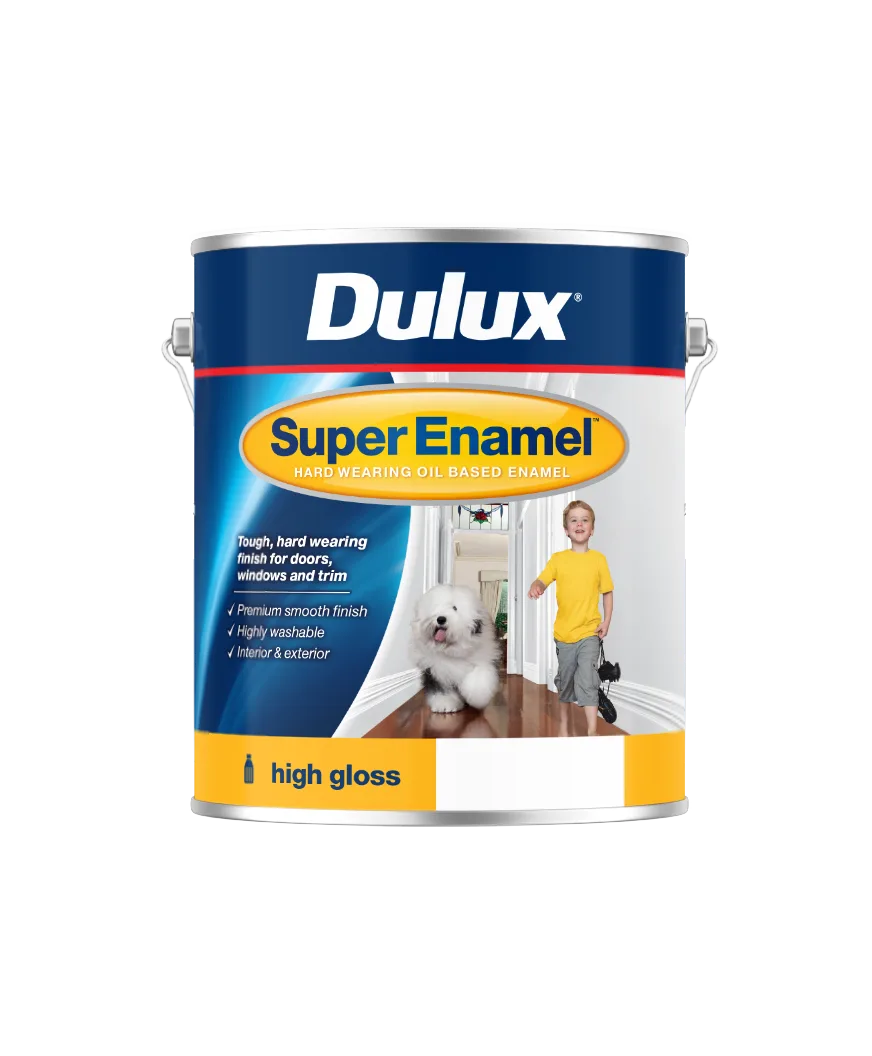

Dulux Super Enamel™ High Gloss is a high quality and hard-wearing oil-based enamel. With superior flow and levelling, Dulux Super Enamel™ High Gloss helps achieve a premium smooth finish for doors, walls and trim in your bedrooms, living room, halls, dining room, bathroom, laundry and kitchen.

Touch Dry
4 hours

Re-coat
16 hours

Cleaning materials
Mineral turpentine
Application Tools
Brush, Roller, Spray
All preparation and painting must conform to AS2311: The Painting of Buildings.
Occasionally an apparently sound old paint will lose adhesion when recoated, particularly if the new paint is darker in colour. To avoid this, check the adhesion of the old paint by cutting an 'X' through the film with a razor blade or trimming knife, pressing cellulose tape firmly across the cut and rip if off. If the old paint comes off with the tape it should all be removed before replacing.
Do not apply externally when weather is doubtful, or late in afternoon during winter, as frost, rain or dew on the uncured film may result in complete loss of gloss or patchiness, and impair durability.
Tinter, if added, should be shaken and stirred in immediately and thoroughly. All enamels will yellow with age. This can be accelerated by darkness, heat and exposure to ammonia from freshly painted acrylic paints and some cleaning agents, particularly during the drying period. Darker colours will show more signs of marking and scuffing than lighter colours. Dark colours provide a background against which any foreign material on the surface – even a thin clear film – can be seen as a localised difference of colour and/or gloss against the surrounding area. This is, unfortunately, endemic across all coating types, no matter what substrate they are applied over.
It is also worth noting dark colours contain high levels of tinters which prolongs the drying time making the coating susceptible to marring and marking during this drying time.
Remove grease, oil, etc. by washing with a commercial paint cleaner. Thoroughly rinse and allow to dry. Acid and alkali contamination should be removed by thorough rinsing with clean water. Efflorescence or mould on plaster, masonry or timber surfaces must be treated. Rust, millscale, oxide deposits, loose or flaking paint or other foreign material on metal surfaces should be removed in accordance with the requirements of the chosen system. Use primer, sealer or undercoat where required.
Brush, roller, conventional or airless spray
Stir contents thoroughly before and during use with a broad flat stirrer, using an upward lifting action.
Brush/Roller
Apply two full coats to the prepared surface. Reduce if necessary with up to 50ml of mineral turpentine.
Airless/Conventional Spray
Suitable for application by all standard spray equipment. If necessary thin with up to 100 ml/litre of Dulux Spraying Thinner.