

Important customer information: Temporary fuel surcharge. Find out more.
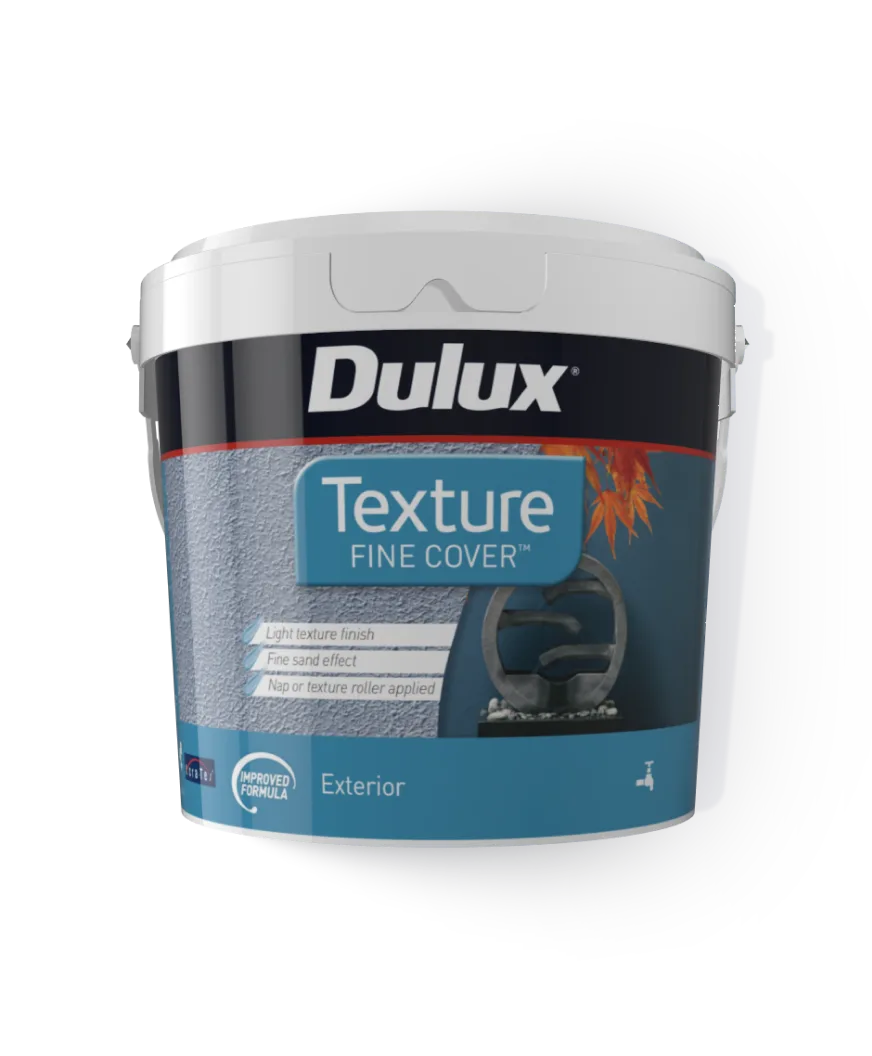
Dulux Texture Fine Cover™ is a flexible acrylic texture for application to bricks, cement render, fibre cement and masonry. It provides a light relief texture profile making it easy to create your perfect look. Apply with a conventional paint roller to create a fine sandy effect or a texture roller to achieve a bolder style.

Touch Dry
1 hour

Re-coat
4 hours

Cleaning materials
Water
Application Tools
Roller, Brush
All preparation and painting must conform to AS2311: The Painting of Buildings.
Do not apply at temperatures below 10C or when the temperature may fall below 10C during the drying period. In summer, paint on the shady side of the building. Do not apply during hot and windy conditions. To ease application, even out porosity and improve coverage, hose down porous surfaces such as concrete block before application. Paint directly on to the damp surface. Application commenced on a single area must be uninterupted. If an area is missed it is best touched up when dry. For best results, work in pairs with one applicator applying the material and the second applicator 'laying off'.
All surfaces must be thoroughly cleaned and free of all dirt, loose and flaking paint. Efflorescence or mould must be treated before application of paint. New concrete, mortar or cement render must be allowed to cure for 4 to 8 weeks depending on concrete thickness and drying conditions. Fill holes with grouting cement. Wash down with water using a stiff brush to remove all loose material. To test the adhesion of previously painted surfaces, cut an 'X' through the existing paint with a sharp blade, press cellulose tape firmly across the cut and then rip the tape off. If the old paint or render comes off, it should be removed.
Long Nap Roller (12mm recommended)
Stir contents thoroughly before and during use with a broad flat paddle, using an up and down scooping action. Using a brush, apply material to edges, internal angles and areas not accessible with a roller. Finish brush applied sections with a dabbing motion.
Generously load the roller and apply from the ground upwards in vertical strips of 1/2 to 1 metre lengths. Reload the roller after each strip and repeat until 3 or 4 strips are applied. Even out material by rolling diagonally across the surface. Apply another strip of wet material to keep a working wet edge and then lay off the previously spread area in either an upward or downward motion to give an even finish. Working in a team can help maintain the wet edge by moving along more quickly.
Two coats are normally required to yield a uniform even texture but this will depend upon application technique and the condition of the substrate.
Need a DuluxTRADE account?Head into your local storeorenquire online now.