
Find out everything you need to know about opacity of whites by downloading the Dulux Technical advice brochure.
Opacity is the term most commonly used to describe the ability of the paint to obliterate the colour difference of a substrate. (Ref: AS/NZS 2310 – Glossary of Paint and Painting Terms).
A fairly well known but commonly misunderstood fact is that the opacity of off-white colours, tinted from a white base with relatively small levels of yellow or bright red tinter, is compromised when compared to the untinted white base.
The opacity or hiding power of a paint film is dependent upon the pigments ability to both scatter and absorb light.
Scattering of light is dependent on the pigment's refractive index – the higher the refractive index, the greater the light scattering hence the better the opacity.
Titanium dioxide, the white pigment used in paint, absorbs very little light but has a relatively high refractive index and for this reason it is widely used in paints to give excellent opacity.
On the other hand, black pigments absorb almost all light and therefore have excellent opacity. The more light the pigment absorbs, the better the opacity or hiding power becomes.
It is important to note that refractive index is not a fixed property, but in fact varies with the wavelength of light. At the blue end of the visible spectrum the refractive index is at its highest point and therefore opacity is at its maximum.
Conversely, at the yellow and red end of the visible spectrum the refractive index is at its lowest point and therefore opacity is at a minimum. This accounts for the lower opacity of yellow and red-toned whites compared to blue or grey-toned whites.
The addition of a small amount of yellow (DD), ochre (EE) or bright red (LL) tinter to a white base will actually reduce the refractive index and therefore adversely affect the opacity. This drop in opacity is not very large but it could be enough to generate the need for additional coat(s) in order to achieve full coverage, depending upon product, application conditions and technique. The addition of larger quantities of these same tinters will however increase the opacity as the colour intensity increases when it begins to absorb more light and this takes over from the scattering influence.
The selection of high opacity white colours that contain black (M) and/or blue (B) tinters will provide excellent opacity, even if some yellow or red tinter is also present. The half and quarter strength versions of these colours will generally also exhibit very good opacity.
The opacity also depends on the overall concentration of pigment in the paint hence darker shades will generally exhibit superior opacity.
There is a likely misinformed belief within the building industry that all colours will obliterate the substrate in two coats of topcoat and that colour choice does not affect the opacity of architectural or decorative coatings. In fact, choice of colour does have a direct bearing on the opacity or hiding power of the paint and unless managed correctly, opacity problems can also affect the tone of a colour, so that the desired shade is not actually obtained. With colours that exhibit less than perfect opacity, it is even more important for full and complete obliteration of the substrate or background colour to be achieved.
Tinted Undercoats should be avoided as they will alter the true colour of the white topcoat. The undercoat needs to be untinted white.
To achieve the best possible results, a three-coat system (one coat of prepcoat followed by two coats of topcoat) is necessary, in accordance with the guidelines contained within AS/NZS 2311(2009) “Guide to the Painting of Buildings”.
The use of high opacity whites will minimise opacity problems on most uniform substrates. The colours in the Dulux Whites Range contain some level of black tinter and therefore should all perform well for opacity. In particular, the full and half strength versions of these colours will all provide excellent coverage.
Warning: Some Dulux colours exhibit poorer opacity, as they contain only yellow and/or red tinter at very low levels. It is therefore reasonable to assume that additional coats of standard topcoat may be required to achieve full coverage, but opacity is affected by other factors such as spreading rate, surface porosity, colour of the previous coating or substrate and insufficient drying between coats which will also need to be taken into consideration.
The introduction of high solids, high tint-strength products such as Dulux Wash&Wear® +Plus Super Hide provides a high opacity tint-base for the poorer opacity colours and for situations where very light colours need to be applied over very dark existing colours.
This product has 60% more prime pigment in the formula hence its substrate obliteration capability is superb however it is important to remember that the Dulux recommended system remains two coats minimum over existing sound paintwork and over suitably prep-coated new substrate.
A detailed explanation and recommended processes can be found in the Australian Standard AS/NZS 2311 “The Painting of Buildings” Sections 1.8.
Information Data Sheet No.17 titled “Opacity of Paints” can be obtained through the Master Painters Association (MPA). Phone: (03) 9813-5922 or Email: mail@mpav.com.au
Further information can also be obtained from the Australian Paint Manufacturers Federation Inc (APMF).
Phone: (02) 9922-3955
Fax: (02) 9929-9743
Email: office@apmf.asn.au
Website: www.apmf.asn.au

Efflorescence is the deposit of crusty white mineral salts that appear on a masonry surface such as concrete, render, brick or mortar.
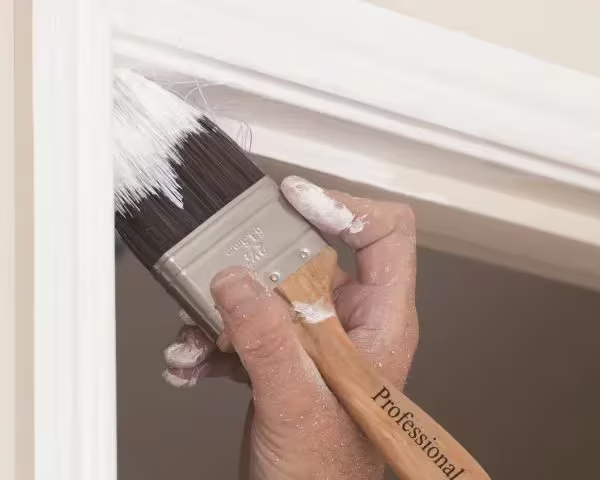
Discover how to touch up a small area of a newly painted surface to conceal repairs to minor damage or to cover up small surface defects.

Discover the differences between water-based and oil-based enamel paints.

All water-based paints undergo a “drying process” involving two distinct phases, evaporation and coalescence.


